search ABOUTAWORD. search links from ABOUTAWORD. search the web.

Sunday, March 14, 2010

Evie Shockley, Top Ten Reasons Why It’s Okay That There Are “Too Many Poets”


10. Because there used to be too few poets (and they really did all know each other then).

9. Because it appears to be okay that there are too many baseball fans. (Granted, that is a bit subjective – but this whole thing is subjective, right?)

8. Because employing the logic of capitalism (supply and demand) to explain the production of art is like using a Minnie Mouse sticker to close a surgical incision—it might seem effective at some point, but it is the wrong tool for the job.

7. Because many of them would otherwise become novelists.

6.Because poets—in the practice of their art—don’t leave a terribly large carbon footprint.

5. Because, as Nikky Finney has said (and this is badly paraphrased), a poet is someone who can’t not write poetry. There aren’t too many of those types. The rest will sooner or later stop writing poetry. All’s well that ends well.

4. Because poets regularly come out of jail, but only rarely go into jail. (The statistics behind this claim are based on an informal survey of my memory, so the margin of error is ±

3. Because, although it is true that poets, like rabbits, have a taste for green, poets generally do not eat through your whole garden, literally or metaphorically (or if they do, they write a poem about how very good it was).

2. Because more poets means more points of view, more experiences, more lexicons, more aesthetic choicesa wider range of voices, by any measure—will be available to the poetry reader. And, likewise, more and different readers of poetry will be called forth. If not inevitably, very probably.

1. Because the existence—and cultivation—of a growing number of people in the world who have a jones for language, a passion for truth, and a weakness for beauty cannot be a bad thing.


Evie Shockley is the author of one book of poetry, a half-red sea (Carolina Wren Press, 2006), and two poetry chapbooks, 31 words * prose poems (Belladonna* Books, 2007) and The Gorgon Goddess (Carolina Wren Press, 2001). Her poems also appear and are forthcoming in numerous journals and anthologies, including Indiana Review, The Southern Review, La Petite Zine, Columbia Poetry Review, Beloit Poetry Journal, Hambone, No Tell Motel, Harvard Review, Crab Orchard Review, HOW2, nocturnes (re)view, Achiote Seeds, Tuesday; An Art Project, Poetry Daily: Poems from the World's Most Popular Poetry Website, Fingernails Across the Chalkboard: Poetry and Prose on HIV/AIDS from the African Diaspora, From the Fishouse: An Anthology of Poems that Sing, Rhyme, Resound, Syncopate, Alliterate, and Just Plain Sound Great, and Black Nature: Four Centuries of African American Nature Poetry. She currently co-edits jubilat; in 2007, she guest-edited a special issue ofMiPOesias (called "~QUEST~")

Evie Shockley blogs at Red Room: Where The Writers Are


Saturday, March 06, 2010

Afaa Michael Weaver, This Tongue of Yours

If I think of where I began, it seems overwhelming. My naivete seems so large and implausible. Forty years after walking into the steel mills and declaring myself a poet, I wonder why no one was able to make me see the difficulties inherent in succeeding in literary life. I find it much easier to talk to poets who feel they have had to live with being given God’s tongue rather than trying to acquire the same. The difference for those of us who feel it was given to us is that we sometimes want to give it back. All along the way, I have resisted the categorizing, the placement, the misperceptions, all the things that come from acting from an inner base and contrary to what most other people move in life when they think they are poets.

“Here God, I think Gabriel could make better use of this tongue of yours. After all, he has wings.”

If ambition and self-loathing are not a recipe for inner turmoil, then there is no such thing as the soul’s chemistry, but there I was, the son of a sharecropper become steelworker, working in the steel mill myself and writing poetry. It has been forty years since I scribbled those juvenile poems that are now a part of the Howard Gotlieb archives at Boston University alongside Dr. Martin Luther King’s papers as well as Walt Whitman’s papers. I knew in the past when I was having to summon a gargantuan courage, but it is only now that I am realizing the courage it takes to begin to make an honest assessment of the distance I have traveled to this point as a poet and writer, of the distance and the depth. The greater wonder is that it feels the way it has always felt in the past when I thought I had established a firm foundation in my writing and my life.

It is good to always think of oneself as a beginner, and from that place pray and work for an honest humility, one that is a quiet acknowledgement of what one has done and hopes to do. Success and critical assessments can make that project of honest humility a harder one to undertake. It has not been easy to even think about my accomplishments as being on the same level as Whitman, to think that I have laid a foundation not just for myself but for my culture.

I think of this comparison in little bits of time, a little at a time. It’s not good to stare into the sun, into God’s eyes.

If you are working class and white, discussion of class is a more recognizable thing, but when you are black and working class, which is to say born working class and working in the working class world, you know discussions of class do not often take place among black people. Someone recently told me that I was playing the “class” card, but I don’t see it that way, especially as the person who told me has had the privilege afforded in the black community by our own strategies of opportunities based on color, including education historically. High school education in better schools in Baltimore, my hometown, was a matter, in the past, of how light-skinned one was. Segregation kept people of different occupations in the same neighborhood, but our social worlds were points of demarcation. My family knew nothing of Cape May’s segregated beaches for middle class blacks in south Jersey. But people who went to those beaches lived in houses that were structurally like mine, although my parents’ home bore the markings of different levels of education and black privilege.

My Kool Aid was not your Kool Aid is one way of pointing up the slowly and begrudgingly emergent discussion of class among black people. For one thing, it threatens that old sense of ourselves as a group that is bound in complex ways in our use of the first person plural pronoun. We are an amazing people is something I still believe.

It was against and within this that I launched myself, determined to use what I was given, as in the biblical story of the ten talents. I know now that it was a matter of coming up the rough side of the mountain, and it was ambition, an ambition made more complex by my inability to embrace whatever success came my way. I just kept moving along like a lumbering freight train until I hit that ultimate destination, me. It was my interface with my childhood that gave me the light to use as a tool of inner illumination. It was when I saw the power of child sexual abuse to configure our lives that I came to understand my writing life and my life, as well as came to understand how my spiritual and truer self is independent of God’s gifts.

God’s gift is life itself.

God’s gift requires recognition, recognition of ourselves by ourselves. There are nearly forty boxes of documents and artifacts in those archives at Boston University that verify most, if not all of the stories I have told people over the years, stories that seem almost incredible to me, but are made credible by affirmations of that terrifyingly beautiful tongue, the tongue that some of us are given, and which we can only see as a blessing when we let go the thing that drives us, ambition and the will of the ego, the will to fame.

Why do I write? I write because it is the work that I do, and I am working class in nature, although I have a professor’s office next to a park where Canada geese have the unmitigated gall, the temerity to stop traffic whenever they please.

That’s a long, long way from East Baltimore and the steel mills, my beginnings, as now I begin once more.


Afaa Michael Weaver (b. Michael S. Weaver) is a poet, playwright, short fiction writer, translator, editor, and journalist. He has been an NEA fellow, a Pew fellow and a Fulbright scholar. In 2008 he received a Pushcart prize. His tenth collection of poetry is The Plum Flower Dance (U Pitt 2007). His eleventh collection of poems, Kama i’reeh (Like the Wind, a translation of newer and selected poems of his into Arabic by Wissal Al-Allaq is in press. Afaa works with poets in China, Taiwan, and Hong Kong and holds an endowed chair at Simmons College. His websites are: www.afaamweaver.com & www.transpoet.com

Monday, March 01, 2010

Sandy Tseng, Tragedy and Art


We’ve all seen it before—the undeniable connection between tragedy and the creative process. I have never been good at humor, wit or rhyme, but take a tragic event—my own loss or someone else’s—and I feel thoroughly consumed by it, fueled by it, energized to write for days, even weeks or months.

When my husband joined a team of medical professionals from Denver to go to Haiti last month, I had never felt so unhelpful as I had watching them pack up 1500 lbs of medical supplies. There we were, working around the clock on a few hours of sleep to get the team ready to go, and I didn’t know enough about medicines and supplies to help pack their duffle bags. I did, however, appreciate learning two new drug names, Ketamine and Lidocaine—words that were sure to contribute to a poem eventually. Throughout the night, someone would mention the drugs again, and while I never noted the context, the musicality of those words echoed in me, rolled off my tongue. How many feet were in those words? I mouthed the syllables and counted the stresses on my fingers. Could the words be used in the same line? Ketamine. Lidocaine. That all depended.


I saw the medical team off at the airport at 6am on a Sunday morning, and it was a good hour to get started on my writing. Yes good luck, team--I’ll just be hanging out in Denver, writing. Let’s face it. There’s a reason someone doesn’t study medicine. I couldn’t assist in surgery even if someone gave me an instrument and told me exactly when to hand it to the surgeon.

But then something exciting happened after the team returned to Denver. The entire team of 11 medical professionals began talking enthusiastically about writing a book together. Each of them had an insatiable desire to express what they had experienced. Did they go as doctors and nurses and come back as writers? Were they driven, for the first time, by the inexorable energy that produced art?

Amidst the team’s talks of memoir writing, I can only begin to imagine the energy running through the Haitian artists at this time. I am sure that the energy in the Haitians is many times more inspiring and empowering than what we are experiencing. What we don’t see on CNN is the Haitians singing, dancing—celebrating art—in spite of tragedy.


And every one of them has a tragic story. The artist Joseph Sandral, whose banana bark collages my husband purchased in Haiti, lost his daughter during the earthquake. The artist Thamara, who made boxes and jewelry out of cow horn with her father, lost her husband whom she just married in mid-December. We receive these updates through Matthew 25 House (http://blogs.capecodonline.com/cct-haiti/), where the team stayed, and where there was once an artisan shop featuring paintings, banana bark collage, jewelry, wood and metal sculptures by over 20 artists. Many of the artists continue to stop by the house, and they are able to receive some money for food because of the artwork that volunteers purchase while passing through. Despite the circumstances, the artists continue to endure, and they continue to produce art.

There is a power in art that has the ability to bring us through tragedy time and time again. Art is as essential to our survival as food and water. We require it as a form of self-expression. Art is an act of mourning, it’s an acknowledgment, and it brings healing. It is a rebuilding process. If it is possible, in the five days spent in Haiti, to make writers out of doctors and nurses—to inspire memoirs out of people who have never expressed an interest in writing—then the Haitians are indeed rebuilding themselves. This is their rebuilding process. They are building mansions in place of shacks, and they will rise in the spirit of their music and dancing. Many people are asking how this poverty stricken country can ever recover, but indeed they will rise out of the rubble. Out of the graves of their loved ones, they will rise.


Sandy Tseng


Sandy Tseng is the author of Sediment, published by Four Way Books in October 2009. Among her awards are The Nation's Discovery Award, the Louis Untermeyer Tuition Scholarship from the Bread Loaf Writers’ Conference, and the Vira I. Heinz Foundation scholarship. She has held residencies at the MacDowell Colony and Virginia Center for the Creative Arts. Currently a resident of Colorado, she teaches at Metropolitan State College of Denver.

Monday, February 15, 2010

Jacqueline Jones LaMon: Demons, Bodies, and the Rustling in the Wild

Later this week, Victor LaValle, our visiting fiction writer at Adelphi University, will be leading an open discussion on why writers write. The longer I engage in this activity, the more interested I am in the answers to this question. I know the answers I’ve given over the years, which range from, “To give voice to those who have no voice,” to “Because I have a need to,” but I’m not so certain that any one of those responses truly addresses the motivations behind my actions.

Writing is terrifying. Facing that blank page and approaching it with honesty and openness is not an activity for the faint at heart. We play these little tricks on ourselves, saying that the particular piece under construction is just a draft or an entire fiction, written for the eyes of no one but ourselves, but it doesn’t always work. It takes a great deal of courage to speak truth, even when no lives are seemingly on the line or we convince ourselves that no one is listening. The potential for an eventual reader is always present, and we always know this. We know this, and we do it anyway. We engage in an activity that gives tangible life to thought and impression. A piece of writing allows the reader to hold the thoughts of the writer, in a very literal sense. Writing gives those thoughts a body and if the time should come when that body is destroyed, the meaning contained in the writing still lives on.

The more I realize the potential impact of writing, the more in awe of it I become. There are times when I write to discover and refine my perspectives, to figure out how I truly stand on an issue. But in the last few years, my poems have increasingly taken up the task of filling in the blanks of life, of serving as a form of instruction. I wonder now if it is possible for us to write that which we truly do not know. Is there something inherent about the act of writing that allows for the entrance of spirit far beyond our individual experiences?

I think of my writing as a braid of joy, responsibility, and terror—not unlike the feeling of a first-time mother left alone with her newborn in the wilderness. I know a variety of ways of how to approach the page, but each day brings a new experience and a new revelation. Most days, I choose to focus on the joy of the act itself and turn away from the incessant demons rustling in the distance. Maybe a life of letters actually means that we are the ones that must summon the courage to coax out those demons, and pen a series of books about the process.

As a teaching poet, I want my students to walk away with a healthy respect for both the art and the craft of poetry. I want them to crave a steady diet of poetry in their lives and I want them to fortify themselves with technique and revision. They don’t know it yet, but there will come a time in their writing lives when their poetry will evolve beyond the workshop, beyond the line break, and even beyond the form. Their poetry will become more than the sum of its parts. Maybe this is what Lorca had in mind as he tried to describe to us our Duende. And today, this is why I write: to evolve into the woman I was not yet yesterday, to offer cavernous entrances for the reader between my lines, and to share those new worlds with honesty and reverence.


(In Memoriam: Lucille Clifton, 1936-2010)


Jacqueline Jones LaMon is a graduate of Mount Holyoke College, UCLA School of Law, and Indiana University Bloomington, where she earned her MFA in Poetry. A graduate fellow of Cave Canem, her first poetry collection, Gravity, U.S.A., received the Quercus Review Press Poetry Series Book Award. Her first novel, In the Arms of One Who Loves Me, was published by One World/Ballantine Books. She is Director of the MFA Program in Creative Writing at Adelphi University, where she teaches poetry, literature, and pedagogy.

Saturday, February 13, 2010

Wendy S. Walters: In These Times

This past week an earthquake with a magnitude of 3.8 shook the small town of Pingree Grove, IL forty miles northwest of Chicago. The earthquake was 1600 times milder than the one that tore down Port-au-Prince a month ago. Despite the lack of catastrophe, the Illinois earthquake caused rattling in many homes throughout the Wabash Valley Seismic Zone. The quake appears to have happened along an unknown fault line, which seems to suggest that there may be a number of small fractures extending throughout the state.

In an unrelated incident, two coyotes were seen wandering around the Columbia University campus in upper Manhattan in early morning hours over the weekend. Their appearance was noted by several students and confirmed by campus police, who were unable to apprehend the animals as they fled from the attention of worried onlookers. Weeks earlier, another coyote had been spotted wandering the neighborhood of West Harlem. For those unfamiliar with the area, West Harlem and Morningside Heights, where Columbia is located, are heavily urbanized. The presence of coyote in these regions is unusual, as they tend to be intimidated by people, traffic and loud noises. It is unclear what suffices for prey in these environs.


Lately I spend a lot of time trying to locate the geography of the work. I believe the writing is someplace. While always true, facts of location are always temporary. And while current events seem to confirm this point for me over and over, somehow I still go out to try and find the line. Whether this is a problem with poetry or a problem with me matters less, I think, than the mistake of not feeling how much wildness is naturally occurring wherever it is the search for the poem takes me.


In these times, naturally occurring wildness has me worried. (How about you?) I do not know how to put events in order. I do not know how often catastrophe is the beginning or end of the word. (What do you think?) The point of the poem makes less sense once it is done than when I am doing it. Whenever I smell futility, I hunt my work down to destroy it. Whenever I feel the ground beneath me cracking, I let my work fall into the chasm. (How do you do it?) Still I think to be subsumed by fear is one kind of avoidable madness. To put the words in order might be a way of noting the difference between now and now. To put the words in order could also be catching my breath. Then there it goes.


Wendy S. Walters

www.wendyswalters.com


Wendy S. Walters’ work resides at the intersection of the poem, essay and lyric drama. She is the author of Longer I Wait, More You Love Me (2009) and a chapbook, Birds of Los Angeles (2005), both published by Palm Press (Long Beach, CA). Walters’ poetry has been recognized with residency fellowships from Breadloaf, MacDowell and Yaddo, and her poems have recently appeared in Callaloo, HOW2, Natural Bridge, Seneca Review and the Yalobusha Review,Seneca Review, Seattle Review, and Harper’s Magazine. among several others.

Tuesday, January 19, 2010

Guston in Grasmere: The Poem-Pictures


... misunderstood and castigated by the art world, he sought the company of writers and poets, amongst them his Woodstock neighbour, Philip Roth and the poets Bill Berkson, Clark Coolidge, William Corbett, Stanley Kunitz, and Guston's wife, Musa McKim. From these friendships came an astounding series of collaborations: the result was not illustrated poetry, but a hybrid art-form of intermingled words and mysterious images, which were called 'poem-pictures ...

from
Dove Cottage: Wordsworth Museum and Art Gallery

Tuesday, January 12, 2010

Douglas Kearney, Black Automation

I need to warn you that I'm really about to gush. Now, I don't mean gush in a girly way, but gush in a deep-book-language-poetry-artsy way.

Doug Kearney is one of the most creative people I've ever met. That says a lot since my life, my career, and my recreation center around creative poetics and prose, and arts and culture. He refers to himself on his web page as
Poet/Performer/Librettist/Educator, which in some ways doesn't cover the range of his talent, but more importantly, his skill. He has the visual sense of a graphic artist and the aesthetic consciousness of a painter. He has the ear of a musician. He has the mind of an architect who is also a linguist. He has the spirit of a poet, and the tongue of a storyteller. He has created poetry of the kind I have never, ever seen before, and yet, the work is immediately a delight, sometimes a privilege to be immersed in it.


I'm still gushing, I know, but the bottom line is that there is no limit of respect and awe I hold for this writer.
I can say, personally, that I've read this book three times, which is a great testament given that I tell my own students, each term, their goal as writers should be to produce something that their readers are compelled to pick up and read again, to go back to, to remember while they are shopping in the super market, on the train. I imagine, off in California where everything seems a bit magical in some way, his instruction is a gift and his students are some of the luckiest young writers in the country.

His new book Black Automation is a treat for the eye as well as the ear. I cannot imagine being a reader of Contemporary Poetry and not having this text in your collection. Hats off to Fence Books for seeing real talent, and investing in it. I applaud his work, and I'm certainly not the only one, as you'll see if you read on.

I've taken the liberty of excerpting some information from Fence Books and thank them ahead of time for not blacklisting me for doing so (insert smiley here).

THE BLACK AUTOMATON
Douglas Kearney
Winner of the National Poetry Series
From ambivalent animals thriving after Katrina to party chants echoing in a burning city, The Black Automaton troubles rubble, cobbling a kind of life. In this collection bodies at risk seek renewal through violence and fertility, history and myth, flesh and radios.

"First, you have to see Douglas Kearney's visual poems, which cheekily diagram cultural memes as if they were parts of speech (as they are). The Black Automaton has its share of sharp, tender lyrics, too...these exploit the political possibilities of puns and the way meanings hinge on inexact resemblance. Kearney's poems tweak and skewer pop culture and literary sources from Paul Laurence Dunbar to T. S. Eliot to traditional ballads and blues...Kearney's work turns poetic and cultural conventions disquietingly inside out."
—Catherine Wagner

Douglas Kearney's work as a poet, performer and librettist has been featured in many venues in print, in-the-flesh and in digital code. His first book, Fear, Some, was published in 2006 (Red Hen Press). In 2008, he was honored with a Whiting Writers Award. He lives in the Valley with his wife and teaches at California Institute of the Arts. For more info, go to his personal web site: www.douglaskearney.com

"Douglas Kearney's innovative new collection makes me tremble like a "mouth and mind full of fish hooks." It makes me think of the despair at the heart of ecstasy; of restlessness as a kind of anodyne. These poems literally vibrate with Kearney's precocious intellect and passion. They hum, they bang, they bite. This is a jaw-dropping, electrifying book. What else can I say? I have never encountered poetry like this before."
—Terrance Hayes, author of Lighthead and Wind in a Box

"We inhabit a world of automata, complicities, complacencies, sound waves, soundless suggestive sales pitches and blaring lingo-infested jingles, machines, robots, rotgut and gut-wrenching city-burnt silences, slave ships, space ships, straitjackets, samples, metonyms and nimble meta-limbs angling gangly nomenclatures, singularities, consecrations and condemnations, assassinations and ass-backward nations, disgraced antonymic masses of matter jostling in unchosen seas, types in stereo singing syncopated tunes out of time with the lock-step of what we might have been supposed to think. What good is poetry in such a world? No good. Not good, useful: "righteous art is a rod./rods are very useful." The Black Automaton is a whip-smart lightning rod: use it."
—Jen Hofer, author of one and translator of sexoPUROsexoVELOZ+Septiembre (Dolores Dorantes)

"Kearney's poetry flows from a consideration of urban speech, negro spontaneity and book learning not easily parsed if you haven't fully digested every major hiphop lyric composed between 1979 and 1983 and spent a considerable amount of time backtracking the library stacks stuffed with Zora Neale Hurston and Ishmael Reed's neofolkloric trails. The Black Automaton is the graphic afterbirth of a Jeep with a booming system driven at 90 mph into a stack of Bibles, small press journals and the Tibetan Book of the Dead by a man who mistook his mouth for a sledgehammer."
—Greg Tate is a writer/musician currently working on a book about James Brown and is still HNIC of Burnt Sugar, The Arkestra Chamber


Radio

the first black you met was on the radio.

this is true even if you lived with blacks.

the first black to speak the word radio

knew it meant the same as blood.

the first black to know blood meant radio,

claimed radio meant love, to better lure you.

the first black you dreamed about was on the radio

and waited for you there each night to fuck you,

you still believe this and sleep with the radio

on or off; it all depends.

the first blacks to realize they were blacks became radios

at once, singing something that could never be english.

the first black to confess it was a radio

did so to account for the snow filling its voice.

the first black you heard was a radio

and did not speak english even if it did: radios cannot speak.

the first blacks to change radio's

meaning from love back to blood are still here

and want to fuck you. they are doing so on the radio

right now. you don't like it but go to sleep.


Tallahatchie Lullabye, Baby


cattail cast tattles Till tale,

lowing low along the hollow.

crickets chirrup and ribbits lick-up.

what's chucked the 'hatchie swallow.

skin scow skiffs upon pond scum skin

going slow along the hollow.

now may mayfly alight brown brow.

what's chucked the 'hatchie swallow.

maybe bye baby bye baby by and by—

lowing low along the hollow—

we will slip the knot not slip will we?

what's chucked the 'hatchie swallow.

who's a bruise to blue hue 'hatchie,

going slow along the hollow?

who's a bruise to whose hue, 'hatchie?

what's chucked the 'hatchie swallow.

Kodak flash tattles Till tale

going slow among the hollow.

who's a bruise to bruise hue?

swallow what the 'hatchie chucks.

—Emmett Till (1941–1955)


Tuesday, December 29, 2009

Samiya Bashir, Gospel

from RedBone Press
Gospel is an ecumenical resistance song in four parts. We enter at the crossroads, tripped up by trickster deity Eshu-Elegba. A chorus of crows, led by Norse god Odin’s raven messengers Hugin & Munin*, guides us into each movement. In this passionate follow-up to 2005’s Lambda Literary Award finalist, Where the Apple Falls, Bashir’s poems challenge truth to stare down the power of fear and paralysis.

"We intended gospel to strike a happy medium for the down-trodden," said gospel music pioneer Thomas Dorsey. "This music lifted people out of the muck and mire of poverty and loneliness, of being broke, and gave them some kind of hope anyway. Make it anything but good news, it ceases to be gospel."

The good news is that we are neither alone in our mess, nor alone in our grasp of the tools to heal. In this pull-no-punches collection Bashir lays down a road map, a portable flashlight, and a shaky-legged escort to usher the way toward recovered sight and strength.

Mosaic Magazine
Bashir gathers stories and language from a range of cultural locations and weaves them into the imagistic and sonic qualities of the poems. The Norse gods make a dramatic and cacophonous appearance and, in one of her most effective rhetorical moves, Bashir utilizes a Ghanian call and response sequence that both effectively heightens the drama and energy in the poem and then brings it to rest at its conclusion. The poems of Gospel are rife with layered meanings while they immerse the reader in a landscape that is both familiar and reassuring as well as deeply unfamiliar and strange.

Gospel, like all good preaching, is both deftly reflective and full of rafter-rattling truths. In a voice stamped with her definitive, soul-drenched signature, Samiya Bashir blesses us with a roadmap for the living of our fractured and uprooted lives, forcing us to take an unflinching look at faith and the way it’s defined. This is a grandmama-braiding-the-hair book, a rev-ripping-up-the-pulpit book, a book you'll constantly come back to for both beauty and guidance.
—Patricia Smith, author of Blood Dazzler

Luminous and deeply shadowed, at times gravely playful, and always intimate, Gospel sings through—and beyond—ancestral and personal terrains simultaneously mysterious and revealed, to achieve a richness that is both exhilarating and sublime. Here are movements that, through rhythm, language, and light, become exactly what the poet envisions: gospel.
—Thomas Glave, author of The Torturer’s Wife

--from Samiya Bashir dot com

Dawn Lundy Martin, A Gathering of Matter / A Matter of Gathering

from University of Georgia Press
Dawn Lundy Martin is scholar, poet, and activist.

Dawn Lundy Martin teaches in the MFA program at the University of Pittsburgh. She received her MA in Creative Writing from San Francisco State University and her PhD in literature at the University of Massachusetts/Amherst, with a dissertation titled, “Saying I Am: Contemporary Experimentalism and Subjectivity in Poetry by Myung Mi Kim, Marlene Nourbese Philip, Claudia Rankine, and Harryette Mullen.” Her book, A Gathering of Matter/A Matter of Gathering: Poems (U of Georgia Press), was selected by Carl Phillips for the 2006 Cave Canem Book Prize. She has also published two chapbooks: The Undress (belladonna books, 2006) and The Morning Hour (Poetry Society of America, 2003), the latter of which won the Poetry Society of America Chapbook Fellowship. Dawn has published essays and poems in magazines and journals, including Crossroads Magazine, Nocturnes and Callaloo. With Vivien Labaton, she also co-edited The Fire This Time: Young Activists and the New Feminism (Anchor Books, 2004), a book which both describes and theorizes current activist work in the U.S. She is the co-founder of the Third Wave Foundation (New York), an organization designed to “articulate a feminism appropriate to changing culture,” and she is a founding member of The Black Took Collective, an experimental performance art/poetry group. She has taught at Montclair State University, at the New School, and at the Institute for Writing and Thinking, Bard College.

Synopsis
Dawn Lundy Martin’s work is neither language poetry, which rejects the speaking subject, nor strictly lyric, which embraces the speaking “I.” It might best be described as poetry where, in the words of Juliana Spahr, “the lyric meets language”—both an investigation into the opacity of language and the expression of a passionate speaker who struggles to speak meaningfully.

Martin’s poems bend the form into something new, seeking a way to approach the horrific and its effect on the psyche more fully than might be possible in the worn groove of the traditional lyric. Her formal inventiveness is balanced by a firm grounding in bodily experience and in the amazing capacity of language to expand itself in Martin’s hands. She explodes any pretense at a world where words mean exactly what we want them to mean and never more nor less.

The poems are neither gentle nor easy, but they make a powerful case that neither gentleness nor easiness is appropriate in the attempt to contend with the trauma and violence that are an inescapable part of human history and human experience. Martin’s book acknowledges the difficulty but not the impossibility of utterance in trauma’s wake, and it ventures into the unimaginable at many levels, from the personal to the cultural.
Nicole Sealey - Mosaic Magazine

It is the leap, not necessarily the landing, that forces risk and invention. Martin has taken such a leap and, in the process, invented new ways in which to engage and experience language. A Gathering of Matter is an ambitious debut book of poems that does not consult with convention, but rather vehemently argues with it. And, there is something very elegant, ugly, honest, unpleasant and right-minded about Martin's reasoning... With ingenious forms that will test the patience of the most delicate reader of poetry, hers is a persuasive, alternative version void of pretension and artificiality. The authority with which Martin, a newly published poet, writes will astound readers and reviewers alike. And, by the likes of A Gathering of Matter/A Matter of Gathering, we can expect many more pleasant surprises from this promising, award-winning poet.
More Reviews and Recommendations
from Barnes & Noble

Adrien Matejka, Mixology

Selected for the 2008 National Poetry Series by Kevin Young

The poems in Adrian Matejka’s second collection, Mixology, shapeshift through the myriad meanings of “mixing” to explore and explode ideas of race, skin politics, appropriation, and cultural identity. Whether the focus of the individual poems is musical, digital, or historical, the otherness implicit in being of more than one racial background guides Matejka’s work to the inevitable conclusion that all things—no matter how disparate—are parts of the whole.

-- Penguin Books


Adrian Matejka is a graduate of the MFA program at Southern Illinois University Carbondale. He is a Cave Canem fellow and his poems have appeared in Crab Orchard Review, Gulf Coast, Indiana Review, and Painted Bride Quarterly, among other journals and anthologies. His first collection of poems, The Devil’s Garden, won the 2002 New York/New England Award from Alice James Books. His second collection, Mixology, a National Poetry Series winner (selected by Kevin Young), was published by Penguin in May 2009.

-- From the Fishouse

Thursday, December 24, 2009

tara betts, arc and hue

i've been introduced to the concept of the 'book trailer' and i'm fascinated by it. tara betts introduces herself to us as a poet, as a social media 'maven,' and an orchestrator of delivery with the various online outlets in which we can find her sincere work and warm certitude. welcome her book to the forever family of books:


Tara Betts, Arc and Hue
You can network with Tara Betts here
Willow Press

New Fiction from Elisabeth Sheffield: Fort Da

A psychological and linguistic exploration of obsession and illicit love.

While working at a sleep lab in northern Germany, Rosemarie Ramee, a 38-year-old American neurologist, falls in love with Aslan, an eleven-year-old Turkish Cypriot. To get closer to the boy, RR undertakes a "marriage of convenience" to the boy's uncle. But when the uncle suddenly disappears, Ramee, alone with Aslan, must take the boy to his relatives in northern Cyprus. A train journey ensues, chronicled in RR's psychological reports and neurological inquiries.

But what begins as an objective "report" breaks down as the story progresses: RR's voice, hitherto suppressed and analytical, emerges hesitantly and then erupts, splintering every conception of inner and outer lives, solipsistic reality, and the irrevocable past. Consistently surprising and unrelenting, Fort Da turns one woman's illicit affair into a riveting exploration of language and the mind.

Elisabeth Sheffield is the author of the novel Gone. She teaches in the Creative Writing Program at the University of Colorado, Boulder.

This is Lemony Snicket retelling Lolita for an audience that insists it isn't already hopelessly tangled up in the essential American fairy tale. Fort Da [is] brilliant in a careless way, and written even better.

—Stephen Graham Jones, author of Led Feather, The Bird is Gone, Bleed into Me, and All the Beautiful Sinners.

A literary high–wire performance with stunning language. Sheffield makes psychological sense of an ‘aberrant’ sexual behavior and the condition of longing, along with a chase, a European travelogue, and a parody of academia.
—Stacey Levine, author of My Horse and Other Stories, Frances Johnson, and Dra–.

from the
University of Alabama Press

Selected for the 2009 Sawtooth Poetry Prize by Rae Armantrout


100 Notes makes use of multiple sources, and so is not merely a subjective account of violence and its effects, but also a research project. For example, I quote from such authorities on violence as Elie Wiesel, Hannah Arendt, Susan Sontag, Dostoevsky, William T. Vollmann, and Georges Bataille. I also include information from books and websites on issues such as childhood depression, child abuse, and gun control. I have also sourced material from many stories told to me in person, over email, or discovered in fiction and film. Included as well are events from the news.
-- Julie Carr (from
Author Statement)


100 Notes on Violence
Julie Carr
Ahsahta Press

Wednesday, December 23, 2009

Split This Rock and Chris Abani

Split This Rock Poem-of-the-Week: Chris Abani


The New Religion

The body is a nation I have never known.
The pure joy of air: the moment between leaping
from a cliff into the wall of blue below. Like that.
Or to feel the rub of tired lungs against skin-
covered bone, like a hand against the rough of bark.
Like that. "The body is a savage," I said.
For years I said that: the body is a savage.
As if this safety of the mind were virtue
not cowardice. For years I have snubbed
the dark rub of it, said, "I am better, Lord,
I am better," but sometimes, in an unguarded
moment of sun, I remember the cowdung-scent
of my childhood skin thick with dirt and sweat
and the screaming grass.
But this distance I keep is not divine,
for what was Christ if not God's desire
to smell his own armpit? And when I
see him, I know he will smile,
fingers glued to his nose, and say, "Next time
I will send you down as a dog
to taste this pure hunger."


-Chris Abani
From Hands Washing Water (2006). Used by permission.
Chris Abani's poetry collections are Hands Washing Water (Copper Canyon, 2006), Dog Woman (Red Hen, 2004), Daphne's Lot (Red Hen, 2003), and Kalakuta Republic (Saqi, 2001). His prose includes Song For Night (Akashic, 2007), The Virgin of Flames (Penguin, 2007), Becoming Abigail (Akashic, 2006), GraceLand (FSG, 2004), and Masters of the Board (Delta, 1985). He is a Professor at the University of California, Riverside, and the recipient of the PEN USA Freedom-to-Write Award, the Prince Claus Award, a Lannan Literary Fellowship, a California Book Award, a Hurston/Wright Legacy Award, a PEN Beyond the Margins Award, the PEN Hemingway Book Prize, and a Guggenheim Award. Library Journal says of Hands Washing Water, "Abani enters the wound with a boldness that avoids nothing. Highly recommended."
Abani will be featured at Split This Rock Poetry Festival: Poems of Provocation & Witness, March 10-13, 2010, in Washington, DC. The festival will present readings, workshops, panel discussions, youth programming, film, activism-four days of creative transformation as we imagine a way forward, hone our community and activist skills, and celebrate the many ways that poetry can act as an agent for social change.
For more information: info@splitthisrock.org.

Please feel free to forward Split This Rock Poem-of-the-Week widely. We just ask you to include all of the information in this email, including this request. Thanks!


Split This Rock
www.splitthisrock.org
info@splitthisrock.org
202-787-5210

Thursday, February 01, 2007

10 reasons to love rilke...

...as if you needed any more:

1. beauty is nothing/ but the beginning of terror, which we still are just able to endure,/ and we are so awed because it serenely disdains/ to annihilate us. Every angel is terrifying.

2. fling the emptiness out of your arms/ into the spaces we breathe; perhaps the birds/ will feel the expanded air with more passionate flying.

3. O smile where are you going? O upturned glance:/ new warm receding wave on the sea of the heart...

4. Oh the Neptune inside our blood, with his appalling trident./ Oh the dark wind from his breast out of that spiraled conch./ Listen to the night as it makes itself hollow.

5. There wasn't a creak that your smile could not explain,/ as though you had long known just when the floor would do that...

6. how could you know/ what primordial time you stirred in your lover. What passions/ welled up inside him from departed beings. What/ women hated you there. How many dark/ sinister men you aroused in his young veins. Dead/ children reached out to touch you...Oh gently, gently,/ let him see you performing, with love, some confident daily task--/ lead him out close to the garden, give him what outweighs/ the heaviest night...Restrain him...

7. O trees of life, when does your winter come?/ We are not in harmony, our blood does not forewarn us/ like migratory birds'.

8. Who makes his death/ out of gray bread, which hardens--or leaves it there/ inside his round mouth, jagged as the core/ of a sweet apple?.....Murderers are easy/ to understand.

9. Each torpid turn of the world has such disinherited ones,/ to whom neither the past belongs, nor yet what has nearly arrived.

10. O Earth: invisible!/ what, if not transformation, is your urgent command?


(all excerpts from Stephen Mitchell's translations of the Duino Elegies)

Thursday, October 19, 2006

Against Which, Ross Gay


I have a significant bias for this poet and this poetry, and so, perhaps I'm an unreliable reader. If so, you can just ask someone who's read this book, or someone who's heard this poet, or someone who's read any of the poems herein what they think, and I would be very surprised if you received anything back but resounding praise (read astonishment) at the rich, tender strength of these poems. It's really as simple as that. Good poetry. If you're on the east coast, you can keep track of his reading schedule by going to the publisher's website, here. I'm including, in place of my own praise, some comments on the book from some other writers whose opinions you may trust.

Against Which by Ross Gay
Foreword by Gerald Stern
72 pagesPaperback
ISBN: 1-933880-00-7Pub Date October 2006

“…What Ross Gay sees, what he sings about, is a crippled woman taking a walk in her wheel chair through the agency of the poet’s strong hands; or two brothers embracing in the death chamber, and the untranslatable song between them; or recovery from pain coalescing with the beginning of spring; or the glorious sexy vision of an ankle, or a midriff; or the blue whale’s deep sea love scream; or football season in late October. He also sings about the rage and violence inside and the urge to destroy; and the horror of Alzheimer’s; and murder; and cancer; and butchered animals and cannibalism; and lynching; and the bullet’s journey—almost, almost too neatly the reverse side of the coin, as if one could prove the other—or lived by the other—as if, in the dream of light, he cannot allow himself to forget the darkness, he is so given over to the honest and accurate rendering, or as if he allows himself a final affirmation so long as he admits, or incorporates, the negative...”-Gerald Stern

Whether he’s talking about the pain of slavery or a child being beaten up on a playground, Ross Gay’s Against Which suggests poetry as the way by which we might understand “birth’s phantom limb.” It makes me think of poetry in an entirely new way.-Toi Derricotte


What a hammer, what a velvet wrecking ball, what a rip tooth saw Against Which is! Ross Gay is a terrific poet of enormous energies and gifts whose poems both “terrify and comfort,” as Berryman put it. This is a book with which we must reckon: read it live.”-Thomas Lux


Litany

say birdsong
at death’s bed-
side plus honeybees
their hover and thirst say
thickets of clover
aquiver the gold
swell limning
morning clouds
the light behind it
say wet eye
sthe orb’s cock-eyed swirl
extubate
say the honey
between nape and scapula
a slow ride
between two points
the plush rug of ivy
swallowing this tree
pissing
in a wood say
the last rattle of the thorax
the peristaltic earth
say home say

Wednesday, October 11, 2006

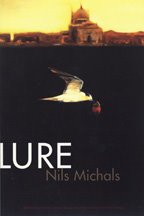
lure, nils michals


there is no greater pleasure for me than climbing the stacks of a new library and trying to find my way around. i am overcome with this trepidation that reminds me of my early undergraduate days at my big state university where everyone but me seemed to know where they were going and what they were doing. there were early weeks in the stacks there where i would tediously spend 40 minutes trying to locate a call number in the card catalogue (yes, the card catalogue) only to abandon my search in the stacks because the whole population of shelves and books just became too overwhelming. i read poetry before getting lost in the stacks, but i might have learned to love poetry in the stacks. i learned to love what i found, not necessarily what i was looking for. and what i found there, accidentally, was the poetry no one had told me about.

a few weeks ago, i finally finished filling out my new faculty paperwork, rearranging the furniture in my office to some suitable assemblage, copying the poems i want my students to take home and put in their heads, etc etc and decided it was time to tackle the library. i made 2 trips and brought home 22 books, 17 the first time, 5 the second (i was really supposed to be attending a faculty meeting on the 4th floor, so i had limited search time). i used my old methods, barring a few specific wants. among my happy accidents was lure, by nils michals.

when i sat on my couch and opened this book for the first time, i read it with the intention to scan, find whether it was worthy of a slow long read, or whether i should put it down for later when i could leap from page to page and find a few favorite lines. i read the book cover to cover. i was immediately intrigued by the language. my heart fluttered. yes, that's a cliche. but cliches are such because they are often true, and this book pulled my heart a little closer to my throat, giving my chest that feeling that it is simultaneously brimming and yet experiencing a thorough emptiness, a well between these two feelings, a surge, an oscillation of loss and gain, all at the same time.

i've been wanting to write an entry for lure from the first reading, but have been caught up in my own pull between loss and gain. because of my own struggle to go out into the world that expects me each day, i think lure has been a particularly important book to me. there have been moments when i am not so invested in the world, and so i cleave to anything that makes me feel anchored in the world, especially the natural world. i find, also, that i have an intolerance for the tender, the beautiful, unless it is somehow tempered with a petulant mettle. michals' natural world is this, tempered with mettle, and yet, as easy as the underside of a leaf. and so, i will ask you to read this without talk about the work line for line. i will not offer you my own similies and metaphors to recapitulate what michals does all too well. but i will give you this opening poem:

WESTERLY
What comes off the sea recalls nothing
of loving a world and for those with eyes
wishing something other than what is seen
it says: listen.
Comes off the sea and does not care, says accept
there may or may not be a hand
in this: a taste of spray,
salt, some origin no longer
encompassing us with calm, says
you are on your own now.
And the shy-grown citizens. City of harbors.
What comes off the sea has tinned the sea
wide and for miles like wheat blown one direction.
Off the sea, the distance it has glassed
faltering, comes near to ask
Who are you, and after you answer,
just sea, air,
nowhere in the giftbearing world a voice
having said salt, water
and in not saying, not a thing we may call quiet,
no voice having sung.

this book is not simply a collection of poems, it is a study. it is a project. it is a well knitted sweater whose intricacies are often obscuredd by a lush surface. there is so much here, so much. go find this book. go now.

Friday, November 25, 2005

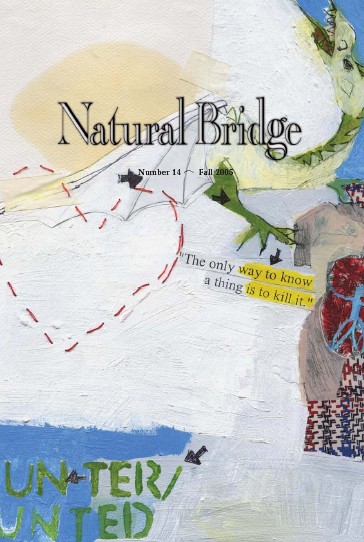
fragment and sequence: natural bridge no. 14


i had the opportunity recently to guest edit natural bridge the literary journal here in the mfa program at university of missouri-st. louis. i've editied a number of other journals, but this was my first experience editing within a literary editing classroom setting with graduate students. the literary editing class was initially daunting becaue i wasn't quite sure how to 'share' the decision making. and as the term progressed, that continued to be a challenge. i soon learned though, that this process was old hat to most of these students. they are serious about the task and all business about the matter of reading and selecting. little by little, i think i was able to think less about my 'control' of the process and function there as a mentor. my contributions to their process included acting as a guide, to encourage them to open their eyes a bit, to not go for the obvious kind of work, to think a bit outside the literary box, so to speak.

we worked under a theme for this issue: fragment and sequence. if you click on the theme, it will take you to my introduction. the theme is a wonderful rubric through which to solicit, read, and evaluate work. we have work in this issue by sapphire, denise duhamel, beckian fritz goldber, timothy liu, rigoberto gonzalez, ross gay, allison stack, tayari jones, ayse papatya bucek, camile dungy, and muzban f. shroff to name just a very few.

editing a journal is always an uphill battle, but i think my students handled the task with the greatest professionalism. i'm proud of this issue. i'm proud of the risks they've taken and the work they've found.

the amazing artwork that graces the cover is from a series of collaborations betwen the poet and painter ross gay and the painter kim thomas. you can see more of their collaborations by going here.

you can preview the issue, find out more about natural bridge, and get information on how to subscribe and submit by going here. you'll be able to read the introduction to this issue as well as read a few selections. happy reading!

Tuesday, November 01, 2005

fishousepoems.org


i've been going to fishouse since i discovered it in the spring time. i'm somewhat awed by it and its ever growing collection of poetry by so many people that i know of and also know and respect. the fishouse collection is unique in its scope and dedication to covering emerging writers.

i was happy to find the voices of some of my most talented friends there: steve scafidi, ross gay, patrick rosal, adrian matejka, camille dungy, curtis bauer, tyehimba jess, shane book, oliver de la paz and so on (i am blessed with many talented friends)...and that's how it began, as a means to get a little bit of the people i long to have more in my life. but slowly i began to branch out, to listen to the other poets, let their recorded voices fill my house as i walked around doing this and that, sit and read through their poems as i heard them echoed. and so i come to discover, then, john pineda--on whom i think i might have an audio-literati crush. well, okay, i'm sure of it--and ravi shanker, and kazim ali, and erika meitner, and quite a few more. as the list of fishouse grows larger and larger, it seems my access to these recordings may eventually grow endless. and god, i love that. i love hearing these voices echoing through my house, filling my view of my back yard, calling out over the running water of my kitchen sink. i love it.

this, of course, raises a whole other question of artistic and literary perspective when we consider the work seamlessly with the writer's own voice. there have been plenty of poets who i've happily read for years and then have been shocked to hear them offer renditions of their own poems i could never have imagined, sometimes, that i wish i hadn't imagined. the most rewarding moments were discoveries of poets whose recitations were more eccentric, more animated and colorful than i expected. this was the case with theodore roethke, who i not only heard recordings of but from whom i was fortunate enough to see, also, film of his reciting of some poems. he was a little flit of a thing, despite his hulking body, a flutter of manhood, a turned hand, an arched foot that brought him up to his tippy toes as he imposed a certain cresendo to the lines...fascinating i tell you. and there are those poets who i will allow to remain un-named whose own readings gave me less than i wanted. no, you won't get those names out of me--not in a million years. and my biggest fear, of course, is to be one of them.

and so, it is a real honor to be the first 'bonus' poet on fishouse.org, that is, a poet, recently emerging, with more than one book to his or her credit. it was an honor and also a bit terrifying. after months of listening to these voices and reading the poems against them i found myself sitting in my bathroom, staring at the peeling fake marble wall paper, speaking into a small red digital recorder and hoping that somehow, my poems would not be slaughtered by me in the process. i don't know how i did, but i can say i avoided do-overs because in my experience i generally do-worse. but, i certainly felt a pang for all of the lackluster poets out there who have made less than impressive recordings that they will have to own up to forever. the digital recorder will not lie. it will not say that i was having a good day when i wasn't. it won't gloss over my allergies, or ignore the plane overhead. it won't just pass up the soap i knocked into the sink. it tells the real story. and isn't that, really, what we're looking for in the work? the real story. the real poet. aren't we always trying to get to him or her? to hone in...

so, go, listen, but be generous. i'm letting you in on this little bit of joy if you don't already know about it. go find a few good poems to listen to.