search ABOUTAWORD. search links from ABOUTAWORD. search the web.

Showing posts with label teaching. Show all posts

Tuesday, January 12, 2010

Douglas Kearney, Black Automation

I need to warn you that I'm really about to gush. Now, I don't mean gush in a girly way, but gush in a deep-book-language-poetry-artsy way.

Doug Kearney is one of the most creative people I've ever met. That says a lot since my life, my career, and my recreation center around creative poetics and prose, and arts and culture. He refers to himself on his web page as
Poet/Performer/Librettist/Educator, which in some ways doesn't cover the range of his talent, but more importantly, his skill. He has the visual sense of a graphic artist and the aesthetic consciousness of a painter. He has the ear of a musician. He has the mind of an architect who is also a linguist. He has the spirit of a poet, and the tongue of a storyteller. He has created poetry of the kind I have never, ever seen before, and yet, the work is immediately a delight, sometimes a privilege to be immersed in it.


I'm still gushing, I know, but the bottom line is that there is no limit of respect and awe I hold for this writer.
I can say, personally, that I've read this book three times, which is a great testament given that I tell my own students, each term, their goal as writers should be to produce something that their readers are compelled to pick up and read again, to go back to, to remember while they are shopping in the super market, on the train. I imagine, off in California where everything seems a bit magical in some way, his instruction is a gift and his students are some of the luckiest young writers in the country.

His new book Black Automation is a treat for the eye as well as the ear. I cannot imagine being a reader of Contemporary Poetry and not having this text in your collection. Hats off to Fence Books for seeing real talent, and investing in it. I applaud his work, and I'm certainly not the only one, as you'll see if you read on.

I've taken the liberty of excerpting some information from Fence Books and thank them ahead of time for not blacklisting me for doing so (insert smiley here).

THE BLACK AUTOMATON
Douglas Kearney
Winner of the National Poetry Series
From ambivalent animals thriving after Katrina to party chants echoing in a burning city, The Black Automaton troubles rubble, cobbling a kind of life. In this collection bodies at risk seek renewal through violence and fertility, history and myth, flesh and radios.

"First, you have to see Douglas Kearney's visual poems, which cheekily diagram cultural memes as if they were parts of speech (as they are). The Black Automaton has its share of sharp, tender lyrics, too...these exploit the political possibilities of puns and the way meanings hinge on inexact resemblance. Kearney's poems tweak and skewer pop culture and literary sources from Paul Laurence Dunbar to T. S. Eliot to traditional ballads and blues...Kearney's work turns poetic and cultural conventions disquietingly inside out."
—Catherine Wagner

Douglas Kearney's work as a poet, performer and librettist has been featured in many venues in print, in-the-flesh and in digital code. His first book, Fear, Some, was published in 2006 (Red Hen Press). In 2008, he was honored with a Whiting Writers Award. He lives in the Valley with his wife and teaches at California Institute of the Arts. For more info, go to his personal web site: www.douglaskearney.com

"Douglas Kearney's innovative new collection makes me tremble like a "mouth and mind full of fish hooks." It makes me think of the despair at the heart of ecstasy; of restlessness as a kind of anodyne. These poems literally vibrate with Kearney's precocious intellect and passion. They hum, they bang, they bite. This is a jaw-dropping, electrifying book. What else can I say? I have never encountered poetry like this before."
—Terrance Hayes, author of Lighthead and Wind in a Box

"We inhabit a world of automata, complicities, complacencies, sound waves, soundless suggestive sales pitches and blaring lingo-infested jingles, machines, robots, rotgut and gut-wrenching city-burnt silences, slave ships, space ships, straitjackets, samples, metonyms and nimble meta-limbs angling gangly nomenclatures, singularities, consecrations and condemnations, assassinations and ass-backward nations, disgraced antonymic masses of matter jostling in unchosen seas, types in stereo singing syncopated tunes out of time with the lock-step of what we might have been supposed to think. What good is poetry in such a world? No good. Not good, useful: "righteous art is a rod./rods are very useful." The Black Automaton is a whip-smart lightning rod: use it."
—Jen Hofer, author of one and translator of sexoPUROsexoVELOZ+Septiembre (Dolores Dorantes)

"Kearney's poetry flows from a consideration of urban speech, negro spontaneity and book learning not easily parsed if you haven't fully digested every major hiphop lyric composed between 1979 and 1983 and spent a considerable amount of time backtracking the library stacks stuffed with Zora Neale Hurston and Ishmael Reed's neofolkloric trails. The Black Automaton is the graphic afterbirth of a Jeep with a booming system driven at 90 mph into a stack of Bibles, small press journals and the Tibetan Book of the Dead by a man who mistook his mouth for a sledgehammer."
—Greg Tate is a writer/musician currently working on a book about James Brown and is still HNIC of Burnt Sugar, The Arkestra Chamber


Radio

the first black you met was on the radio.

this is true even if you lived with blacks.

the first black to speak the word radio

knew it meant the same as blood.

the first black to know blood meant radio,

claimed radio meant love, to better lure you.

the first black you dreamed about was on the radio

and waited for you there each night to fuck you,

you still believe this and sleep with the radio

on or off; it all depends.

the first blacks to realize they were blacks became radios

at once, singing something that could never be english.

the first black to confess it was a radio

did so to account for the snow filling its voice.

the first black you heard was a radio

and did not speak english even if it did: radios cannot speak.

the first blacks to change radio's

meaning from love back to blood are still here

and want to fuck you. they are doing so on the radio

right now. you don't like it but go to sleep.


Tallahatchie Lullabye, Baby


cattail cast tattles Till tale,

lowing low along the hollow.

crickets chirrup and ribbits lick-up.

what's chucked the 'hatchie swallow.

skin scow skiffs upon pond scum skin

going slow along the hollow.

now may mayfly alight brown brow.

what's chucked the 'hatchie swallow.

maybe bye baby bye baby by and by—

lowing low along the hollow—

we will slip the knot not slip will we?

what's chucked the 'hatchie swallow.

who's a bruise to blue hue 'hatchie,

going slow along the hollow?

who's a bruise to whose hue, 'hatchie?

what's chucked the 'hatchie swallow.

Kodak flash tattles Till tale

going slow among the hollow.

who's a bruise to bruise hue?

swallow what the 'hatchie chucks.

—Emmett Till (1941–1955)


Thursday, February 01, 2007

10 reasons to love rilke...

...as if you needed any more:

1. beauty is nothing/ but the beginning of terror, which we still are just able to endure,/ and we are so awed because it serenely disdains/ to annihilate us. Every angel is terrifying.

2. fling the emptiness out of your arms/ into the spaces we breathe; perhaps the birds/ will feel the expanded air with more passionate flying.

3. O smile where are you going? O upturned glance:/ new warm receding wave on the sea of the heart...

4. Oh the Neptune inside our blood, with his appalling trident./ Oh the dark wind from his breast out of that spiraled conch./ Listen to the night as it makes itself hollow.

5. There wasn't a creak that your smile could not explain,/ as though you had long known just when the floor would do that...

6. how could you know/ what primordial time you stirred in your lover. What passions/ welled up inside him from departed beings. What/ women hated you there. How many dark/ sinister men you aroused in his young veins. Dead/ children reached out to touch you...Oh gently, gently,/ let him see you performing, with love, some confident daily task--/ lead him out close to the garden, give him what outweighs/ the heaviest night...Restrain him...

7. O trees of life, when does your winter come?/ We are not in harmony, our blood does not forewarn us/ like migratory birds'.

8. Who makes his death/ out of gray bread, which hardens--or leaves it there/ inside his round mouth, jagged as the core/ of a sweet apple?.....Murderers are easy/ to understand.

9. Each torpid turn of the world has such disinherited ones,/ to whom neither the past belongs, nor yet what has nearly arrived.

10. O Earth: invisible!/ what, if not transformation, is your urgent command?


(all excerpts from Stephen Mitchell's translations of the Duino Elegies)

Wednesday, October 11, 2006

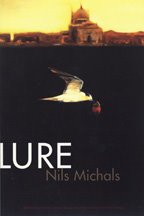
lure, nils michals


there is no greater pleasure for me than climbing the stacks of a new library and trying to find my way around. i am overcome with this trepidation that reminds me of my early undergraduate days at my big state university where everyone but me seemed to know where they were going and what they were doing. there were early weeks in the stacks there where i would tediously spend 40 minutes trying to locate a call number in the card catalogue (yes, the card catalogue) only to abandon my search in the stacks because the whole population of shelves and books just became too overwhelming. i read poetry before getting lost in the stacks, but i might have learned to love poetry in the stacks. i learned to love what i found, not necessarily what i was looking for. and what i found there, accidentally, was the poetry no one had told me about.

a few weeks ago, i finally finished filling out my new faculty paperwork, rearranging the furniture in my office to some suitable assemblage, copying the poems i want my students to take home and put in their heads, etc etc and decided it was time to tackle the library. i made 2 trips and brought home 22 books, 17 the first time, 5 the second (i was really supposed to be attending a faculty meeting on the 4th floor, so i had limited search time). i used my old methods, barring a few specific wants. among my happy accidents was lure, by nils michals.

when i sat on my couch and opened this book for the first time, i read it with the intention to scan, find whether it was worthy of a slow long read, or whether i should put it down for later when i could leap from page to page and find a few favorite lines. i read the book cover to cover. i was immediately intrigued by the language. my heart fluttered. yes, that's a cliche. but cliches are such because they are often true, and this book pulled my heart a little closer to my throat, giving my chest that feeling that it is simultaneously brimming and yet experiencing a thorough emptiness, a well between these two feelings, a surge, an oscillation of loss and gain, all at the same time.

i've been wanting to write an entry for lure from the first reading, but have been caught up in my own pull between loss and gain. because of my own struggle to go out into the world that expects me each day, i think lure has been a particularly important book to me. there have been moments when i am not so invested in the world, and so i cleave to anything that makes me feel anchored in the world, especially the natural world. i find, also, that i have an intolerance for the tender, the beautiful, unless it is somehow tempered with a petulant mettle. michals' natural world is this, tempered with mettle, and yet, as easy as the underside of a leaf. and so, i will ask you to read this without talk about the work line for line. i will not offer you my own similies and metaphors to recapitulate what michals does all too well. but i will give you this opening poem:

WESTERLY
What comes off the sea recalls nothing
of loving a world and for those with eyes
wishing something other than what is seen
it says: listen.
Comes off the sea and does not care, says accept
there may or may not be a hand
in this: a taste of spray,
salt, some origin no longer
encompassing us with calm, says
you are on your own now.
And the shy-grown citizens. City of harbors.
What comes off the sea has tinned the sea
wide and for miles like wheat blown one direction.
Off the sea, the distance it has glassed
faltering, comes near to ask
Who are you, and after you answer,
just sea, air,
nowhere in the giftbearing world a voice
having said salt, water
and in not saying, not a thing we may call quiet,
no voice having sung.

this book is not simply a collection of poems, it is a study. it is a project. it is a well knitted sweater whose intricacies are often obscuredd by a lush surface. there is so much here, so much. go find this book. go now.